Secondary Aluminum Operating Rate Plunged in February March Recovery Was Set to Rebound Significantly [SMM Analysis]

Published: Mar 9, 2026 17:50
[SMM Analysis]Secondary Aluminum Operating Rate Plunged in February March Recovery Was Set to Rebound Significantly

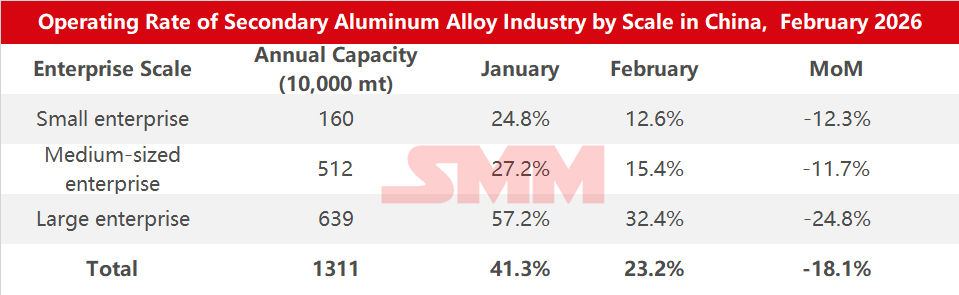
Survey Data on the Operating Rates of Secondary Aluminum Alloy Enterprises by Region and by Scale in February 2026: 
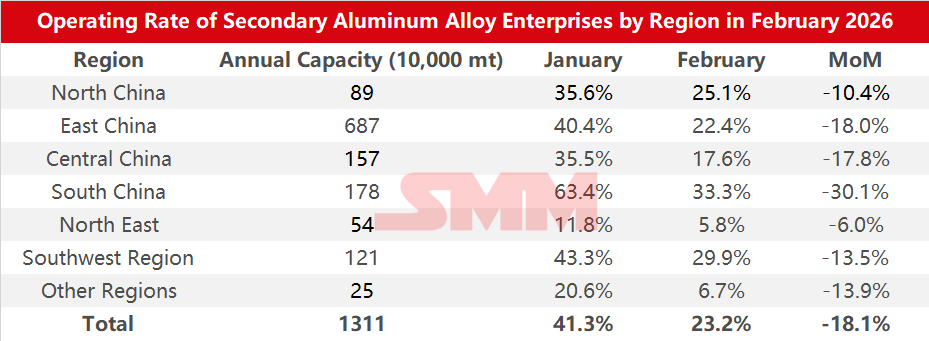
According to the SMM survey, the operating rate of secondary aluminum producers in February 2026 fell by 18.1 percentage points MoM from January to 23.2%, down 9.4 percentage points YoY. In February, operating rates of enterprises across all regions declined sharply.

Affected by concentrated production suspensions during the Chinese New Year, enterprises’ effective production days shortened significantly, and most enterprises saw production declines of 30–50%, leading to a marked contraction on the supply side. In addition, environmental protection-related controls tightened in some regions ahead of the holiday, and with detailed fiscal and tax policy rules such as “reverse invoicing” yet to be clarified, enterprises became more cautious in production. Some enterprises started the holiday early or delayed resuming operations, and a few even approached a full-month shutdown.

Demand also remained weak. Beyond seasonal holiday factors, multiple factors—including pre-holiday destocking by manufacturers, adjustments to purchase tax policies for new energy vehicles, and end-use consumers waiting to see spring auto show promotions—dampened auto production and sales in February, putting secondary aluminum producers’ orders clearly under pressure.

Looking ahead to March, as the industry chain fully resumes operations and automakers’ production schedules gradually recover, both supply and demand are expected to recover in tandem. The industry operating rate is expected to rebound week by week and move closer to normal pre-holiday levels. However, the pace of recovery will still depend on the actual materialization of end-user orders: if demand recovers mildly, the operating rate will rise at a relatively moderate pace; if orders are released in a concentrated manner, together with further clarification of policy expectations, the operating rate is expected to rebound quickly to a relatively high level. 

Data Source Statement: Except for publicly available information, all other data are processed by SMM based on publicly available information, market communication, and relying on SMM‘s internal database model. They are for reference only and do not constitute decision-making recommendations.

For any inquiries or to learn more information, please contact: lemonzhao@smm.cn
For more information on how to access our research reports, please contact:service.en@smm.cn
Related News
SHFE Aluminum Edged Up After Halting Its Decline, Spot Aluminum Stabilized and Improved [SMM South China Spot Aluminum Daily Review]
5 hours ago
SHFE Aluminum Edged Up After Halting Its Decline, Spot Aluminum Stabilized and Improved [SMM South China Spot Aluminum Daily Review]
Read More
SHFE Aluminum Edged Up After Halting Its Decline, Spot Aluminum Stabilized and Improved [SMM South China Spot Aluminum Daily Review]
5 hours ago
SHFE Cast Aluminum Alloy Warrants Drop by 2,047 mt to 42,944 mt on March 24
5 hours ago
SHFE Cast Aluminum Alloy Warrants Drop by 2,047 mt to 42,944 mt on March 24
Read More
SHFE Cast Aluminum Alloy Warrants Drop by 2,047 mt to 42,944 mt on March 24
[SMM Flash News] SHFE data showed that as of March 24, the total registered volume of cast aluminum alloy warrants was 42,944 mt, a decrease of 2,047 mt from the previous trading day. By region, the total registered volume was Shanghai (2,755 mt, down 422 mt), Guangdong (17,257 mt, down 210 mt), Jiangsu (4,209 mt, down 813 mt), Zhejiang (13,672 mt, down 483 mt), Chongqing (3,723 mt, down 119 mt), and Sichuan (1,327 mt, increase 0 mt).
5 hours ago
What Could Change if Middle East Aluminum Trade Reroutes—and Supply Becomes Substitutable
5 hours ago
What Could Change if Middle East Aluminum Trade Reroutes—and Supply Becomes Substitutable
Read More
What Could Change if Middle East Aluminum Trade Reroutes—and Supply Becomes Substitutable
Strait of Hormuz disruptions and Iran tensions are driving up aluminum prices and premiums. Aluminium Bahrain and Qatalum have cut output, while feedstock is tight. Rerouting via Port of Sohar or Saudi ports raises costs and delays. Buyers are turning to China, India, Russia, Canada, and scrap to offset risk. Prolonged disruption could reduce Middle East market share and reprice it as higher-risk supply.
5 hours ago